10 Reasons You Remember Embarrassing Moments So Clearly
1. The Evolutionary Negativity Bias
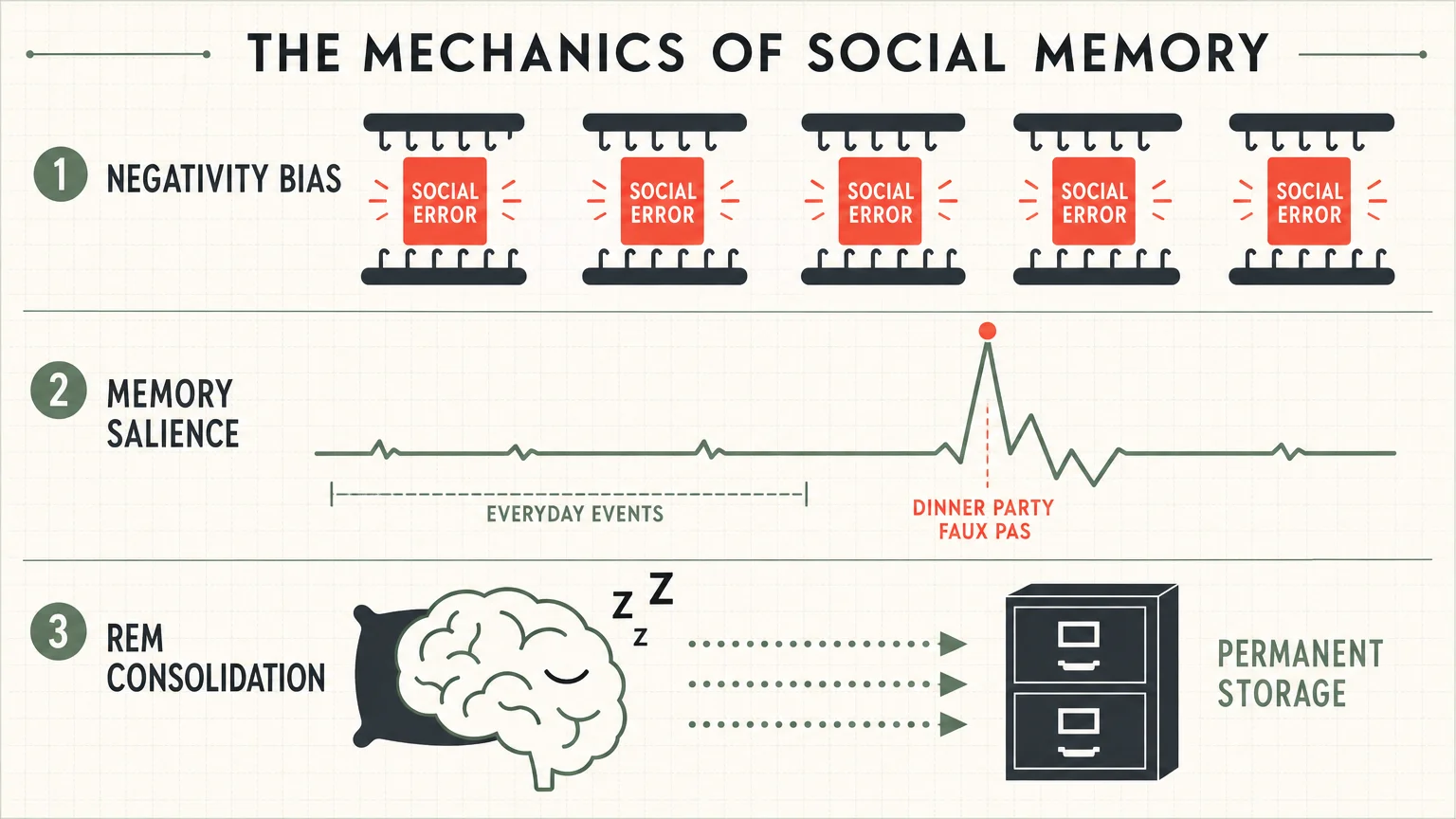
Your mind acts like Velcro for negative experiences and Teflon for positive ones. This negativity bias means your brain prioritizes storing embarrassing memories because it perceives them as potential threats to your social survival.
When you recount a harmless but awkward moment—like calling a colleague by the wrong name or waving at a stranger who was actually waving at someone behind you—your brain catalogs it under high alert. This mechanism served your ancestors well, but today, it often leaves you ruminating over minor blunders that no one else remembers.
You can actively counter this ancient wiring by consciously redirecting your focus and building new, positive neural pathways. Actionable Practice: Perform a mindful check-in the next time an awkward memory strikes. Pause, take a deep, stabilizing breath, and mentally list three positive, successful interactions you experienced today to balance the evolutionary scales.
2. Intense Emotional Arousal Creates Stronger Imprints
Strong emotions act as permanent ink for your memory banks. The sheer panic, flushing cheeks, and racing heart you experience during an embarrassing event signal your brain to record the scene in high definition. The psychology of memory shows that neutral events fade quickly, while highly arousing moments remain stubbornly accessible for decades.
You might vividly recall spilling wine on your lap during a pivotal family gathering because the sudden emotional spike was so severe. Actionable Practice: Use the 4-7-8 breathing technique when a hot flash of embarrassment hits you unexpectedly.
Inhale deeply through your nose for four seconds, hold your breath for seven seconds, and exhale slowly through your mouth for eight seconds. This immediately soothes the physical arousal and tells your nervous system that you are currently safe in the present moment.
3. The Deep Need for Social Belonging
As a highly social species, human behavior revolves around connection, collaboration, and group acceptance. Embarrassment directly threatens your sense of belonging, triggering a deep-seated fear of rejection or harsh judgment from your peers.
You remember the time you tripped on stage or gave the wrong answer in a meeting because it briefly exposed you to public vulnerability. Your brain holds onto that moment to remind you of the high stakes involved in maintaining social cohesion. Actionable Practice: Try a quick journaling prompt to reaffirm your current social safety.
Write down the names of two people who love and accept you unconditionally, noting a specific time they supported you through a difficult moment or laughed warmly with you over a shared mistake.
4. Rumination Deepens Neural Pathways
Every time you replay an embarrassing memory, you strengthen the neural pathway associated with it. This process, known as rumination, turns a faint memory trace into a deeply rutted mental highway. If you habitually mentally review your past mistakes while driving or doing chores, your brain becomes highly efficient at recalling them.
You essentially train your mind to access these memories faster and with greater intensity, making them harder to ignore over time. Actionable Practice: Establish a physical pattern-interrupt habit. When you catch yourself spiraling into a past embarrassing memory, physically change your environment or posture.
Stand up, stretch your arms over your head, or splash cold water on your face to completely break the cognitive loop.
5. Your Identity and Self-Concept Evolve Over Time
As you mature, your values, boundaries, and self-awareness grow exponentially. You often remember past embarrassments clearly because the person you were then clashes dramatically with the wise person you are now. You cringe at a foolish, insensitive comment you made in your twenties because your current self recognizes the immaturity of the statement.
The memory hurts because it highlights the vast gap between your past behavior and your current, refined standards of conduct. Actionable Practice: Write a short, compassionate letter to your younger self.
Acknowledge that they did the best they could with the limited tools and life experience they had at the time, and formally forgive them for the social misstep.
6. The Spotlight Effect Magnifies Your Perception
The spotlight effect is a psychological bias where you firmly believe people are paying much closer attention to your actions, appearance, and mistakes than they actually are. During an embarrassing moment, you feel as though a massive, glaring theatrical spotlight is illuminating your mistake for the entire world to judge.
You remember the event as a monumental, unforgettable disaster, even though most bystanders probably forgot it immediately or barely noticed it in the first place. This creates a confirmation bias—a psychological pattern where you selectively notice information that confirms your worst fears about yourself—making the memory seem even more significant.
Actionable Practice: Engage in a reality-testing reflection. Ask yourself realistically what else was happening in the room during your embarrassing moment. Remind yourself that everyone else is the main character of their own lives, heavily focused on their own potential embarrassments.
7. Unresolved Feelings Seek Emotional Closure
The Zeigarnik effect states that people remember uncompleted or interrupted tasks much better than completed ones. If an embarrassing moment left you feeling misunderstood, silenced, or unable to defend yourself, your brain treats the memory as an open loop.
You continually revisit the scene, desperately searching for a way to rewrite the ending, explain your side of the story, or find emotional resolution. Because you cannot travel back in time to change the past, the memory remains active and demanding. Actionable Practice: Create your own closure by writing a definitive forgiveness statement.
Write down the event, state exactly how it made you feel, and conclude with the sentence, I release the need to fix this past moment, and I choose peace today.
8. Nighttime Vulnerability Increases Flashbacks
Many people find that embarrassing memories flood their minds the moment their head hits the pillow. During the day, physical distractions, chores, and active conversations keep your conscious mind engaged. At night, the sudden darkness and quiet create a mental vacuum, allowing repressed or ignored thoughts to bubble aggressively to the surface.
Your tired brain lacks the cognitive energy required to suppress these uncomfortable recollections, leading to late-night cringing and tossed sheets. Safety Cue: Maintain strong sleep hygiene by avoiding glowing screens an hour before bed and keeping your bedroom cool.
If memories keep you awake for more than twenty minutes, get out of bed and read a calming book until you feel sleepy. You can explore excellent sleep facts and nightly routines at the Sleep Foundation.
9. Triggering Contexts and Sensory Cues
Your brain stores memories in complex associative networks, meaning a highly specific smell, sound, or physical location can instantly retrieve a deeply buried embarrassing memory. You might suddenly remember a mortifying high school date simply because you walked past a stranger wearing the exact cologne your date wore.
These sensory cues bypass your logical, reasoning mind, pulling the painful memory forward with jarring suddenness and intense emotional clarity. Actionable Practice: When an unexpected sensory trigger catches you completely off guard, use a structured sensory grounding exercise.
Name aloud five things you can see right now, four things you can physically touch, three things you can hear, two things you can smell, and one thing you can taste to anchor yourself firmly back in the present moment.
10. Empathy and Heightened Emotional Sensitivity
If you identify as a highly sensitive person or possess deep empathy for others, you naturally process social information far more thoroughly than the average person.
You acutely feel the emotional atmosphere of a room and pick up on subtle facial expressions, which means an embarrassing moment registers as a massive, painful disruption to the social harmony. You remember these events clearly because your delicate nervous system absorbs social data at a heightened volume.
Actionable Practice: Try a brief, silent boundary-setting visualization before entering social spaces. Imagine a soft, protective glowing light surrounding your entire body. Affirm to yourself that you can observe your memories and current surroundings without absorbing the painful or chaotic emotions attached to them.