
Living miles away from your grandchildren can leave an ache in your weekly routine. Small habits turn brief calls and notes into a lasting bond.
You do not need costly flights or long chats to stay close to grandkids. Regular contact helps children remember your voice, your humor, and your care across any distance.
These grandparent tips protect your daily energy while building a stronger family connection. You will find clear routines below for video calls, thoughtful mail, healthy boundaries, and restful visits.
Why Long-Distance Grandparenting Matters After 50
Long-distance grandparenting means staying present in your grandchild’s life when casual drop-ins are impossible. You build closeness through planned rituals instead of spontaneous afternoon visits.
Millions of older adults share this experience today. A September 2026 Pew Research Center analysis found that two-thirds of U.S. adults ages 65 and older were grandparents as of 2024.
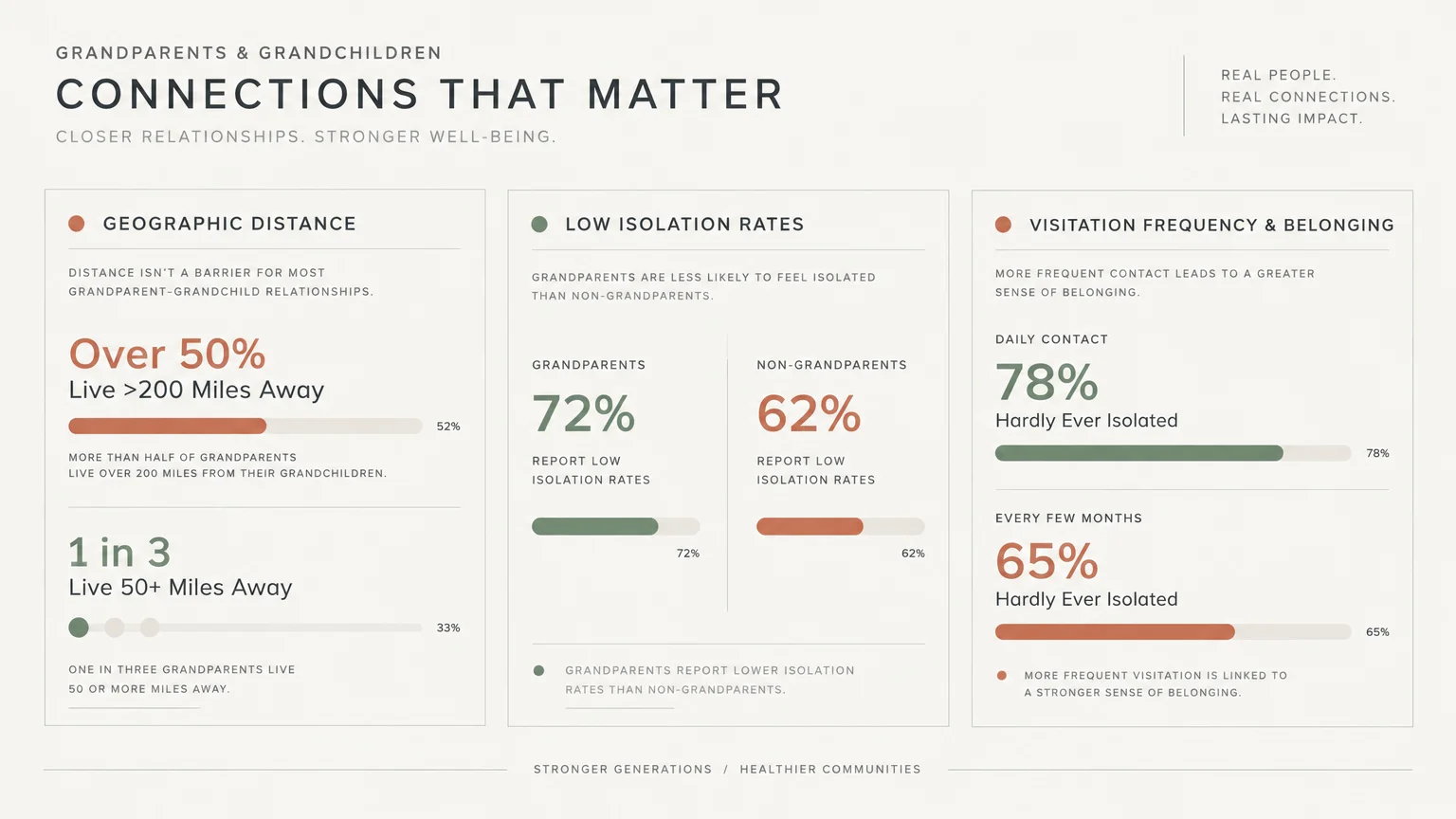
Geography separates many of these extended families. The 2018 AARP Grandparents Study reported that over half of U.S. grandparents have a grandchild living more than 200 miles away.
Nearly one-third live 50 miles or more from their nearest grandchild. Busy schedules create the next biggest hurdle because 4 in 10 grandparents remain in the workforce.
Life after 50 also brings real shifts in your daily energy and sleep. Managing your schedule well lets you show up with warmth without wearing yourself out.
Staying connected supports your emotional wellbeing too. In November 2024, the University of Michigan’s National Poll on Healthy Aging found that 72% of grandparents hardly ever feel isolated.
Only 62% of older adults without grandchildren report the same low isolation. The poll also found that 9% of grandparents report fair or poor mental health, versus 13% of non-grandparents.
Contact frequency shapes those feelings of belonging. Among grandparents, 78% of those who see grandkids daily hardly ever feel isolated, compared with 65% who see them every few months or less.
How Family Connection Works Across the Miles
Children bond through emotional responsiveness, which means noticing their cues and answering with warmth. This exchange works across a screen just as it does on a living room rug.
A 2022 study in the journal Infancy tracked grandparents and infants during video chats. Higher grandparent sensitivity predicted happier emotional responses in babies, mirroring face-to-face play.
Your steady attention matters far more than expensive gifts. Short, predictable moments train both your brain and your grandchild’s brain to expect comfort from each other.
Simple planning tools make these habits easier to keep. Psychologists call an if-then plan an implementation intention because it links a chosen action to a daily cue.
For instance, you can record a voice note right after finishing your morning tea. Linking a new habit to an existing routine removes daily guesswork.
You also protect closeness by honoring an emotional boundary, which is a clear limit around your time and energy. Declining late calls prevents fatigue and keeps you patient.
When plans shift suddenly, you can use cognitive reappraisal. This skill means reframing a frustrating event into a calmer, more realistic view.
7 Ways to Stay Close to Grandkids Who Live Far Away
1. Keep Video Calls Short, Active, and Playful
Many long distance grandparents worry that brief video calls grandkids enjoy cannot build attachment. Research on young children shows that short, lively chats work well.
A collaborative study by AARP, Georgetown University, and the LEGO Foundation examined video chats with children ages zero to five. About 82% of grandparents enjoyed those calls very much.
Most of those calls stayed brief and upbeat. Roughly 68.1% lasted under 30 minutes, while 36.2% lasted between 5 and 15 minutes.
Even babies benefit from seeing your face on a screen. In March 2026, the American Academy of Pediatrics stated that live family video chatting counts as relationship time, not passive screen time.
That exception applies even to infants under 18 months old. For ages 18 to 24 months, pediatric guidance recommends watching quality media together with a caregiver.
For ages two to five, guidance suggests about one hour daily of co-viewed media. Family video calls sit outside that daily media cap.
Interactive play predicts stronger feelings of closeness during these calls. Reading a picture book, singing, or playing peek-a-boo holds a child’s focus better than small talk.
Older grandkids love quick scavenger hunts or five-minute show-and-tell sessions. If you use Zoom’s free Workplace Basic plan, the 40-minute limit provides a helpful built-in ending cue.
Good lighting helps little ones recognize your expressions easily. Sit facing a bright window and place your camera at eye level before dialing.
Actionable practice: Keep a small basket with two props beside your chair before your next call. Pull out a puppet or picture book for a lively 10-minute game.
2. Send Snail Mail They Can Hold and Re-Read
Digital messages vanish quickly from a child’s memory, while a paper envelope feels like a treasure. Children love spotting their own name in the family mailbox.
Sending paper mail stays affordable on any budget. Effective July 12, 2026, a U.S. First-Class Mail Forever stamp costs $0.82, and a domestic postcard costs $0.65.
If your grandchildren live abroad, a 1 oz international letter or postcard costs $1.75.
You can make replies easy for young children too. Tuck a blank, stamped postcard with your address inside the envelope so they can mail back a quick drawing.
Simple environment design keeps this habit effortless. Store a stack of postcards, a pen, and stamps right beside your morning coffee kettle.
Every Tuesday while your water boils, spend two minutes jotting down one short riddle or memory. Your grandchild can tape that card to their bedroom wall and read it anytime.
Actionable practice: Mail one $0.65 postcard this week with three lines about your garden, your pet, or a funny childhood memory. Keep their drawn replies together in one keepsake box.
3. Build Shared Rituals Around Everyday Routines
Grandparents and grandkids grow closest through predictable routines rather than rare grand gestures. Shared rituals give children something reliable to anticipate each week.
You can build a reading ritual across any number of time zones. Buy two copies of the same chapter book, mail them one copy, and read one chapter aloud each Sunday.
When schedules clash, record yourself reading a bedtime story on your phone’s voice app. Parents can play your voice during evening wind-down while you rest comfortably at home.
Kitchen rituals also bridge hundreds of miles easily. Mail your grandchild a simple pancake recipe, then ask parents for a photo when they cook it on Saturday morning.
Send back a snapshot of your own breakfast plate to match theirs. These small mirrors remind children that you share the same caring world.
You can also mark small milestones from afar, like a lost tooth or school concert. Celebrate together with a shared ice cream dessert on camera or a special sticker badge mailed afterward.
Actionable practice: Pick one weekly photo theme, such as funny clouds or backyard birds, and share one image every Friday afternoon. Invite your grandchild to send one matching photo back.
4. Partner With Parents Without Overstepping
Your adult children serve as the bridge between you and your younger grandchildren. Nearly half of grandparents, or 47%, report that parents help direct a young child’s attention during video calls.
Understanding typical contact rhythms lowers your stress too. A Pew Research Center survey published in September 2026 showed that 70% of grandparents ages 65 and older connect at least a few times monthly.
In that group, 15% connect daily, 27% a few times weekly, and 28% a few times monthly. Another 10% connect once a month, while 20% connect less often.
Working parents balance tight schedules around meals, homework, and sleep. In January 2026, the American Academy of Pediatrics released its 5 Cs framework: Child, Content, Calm, Crowding Out, and Communication.
That framework reminds families that screens must not crowd out rest, play, or relationships. Asking parents for their best open window honors their household rhythm.
Boundary phrase to try: Tell your adult child, I know weeknights get busy, so I never expect an instant reply. Text me whenever a 10-minute weekend window opens up for us.
5. Use Kid-Friendly Tech and Simple Messages Between Calls
You do not need to master every new app to stay visible between visits. Brief messages keep your relationship warm in under two minutes a day.
According to AARP’s June 2026 Powering Families study, 76% of grandparents use digital tools like texting and video chats to connect. Half of grandparents over age 80 now text with grandkids.
Traditional phone calls still remain the most common communication method overall. Pairing a quick text or voice memo with your phone calls gives grandkids more ways to hear from you.
For children under age 13, online privacy laws matter greatly. Under the U.S. Children’s Online Privacy Protection Act, services must obtain verifiable parental consent before collecting data from young children.
Many parents use closed-loop apps like Meta’s Messenger Kids for safe family chats. These ad-free apps need no Facebook account and let parents approve every contact and set quiet Sleep Mode hours.
Screen sharing also turns tech into a cozy shared activity. You can read an illustrated e-book together on screen or send family photos straight to a digital frame in their kitchen.
Actionable practice: Send a 20-second voice memo or smiling selfie after your morning walk. Short updates keep you in their thoughts without demanding an immediate reply.
6. Follow a 7-Day Micro-Habit Plan for Steady Contact
Trying to overhaul your family routine overnight often leads to guilt and exhaustion. A gentle seven-day micro-habit plan builds steady momentum in just a few minutes daily.
On Day 1, spend two minutes setting out postcards and $0.82 stamps beside your kettle. On Day 2, text your adult child to ask which day works best for a brief chat.
On Day 3, mail one lighthearted postcard or record a two-minute bedtime story on your phone. On Day 4, jot down one moment of gratitude in a notebook after dinner.
On Day 5, choose one small prop or book for your upcoming call. On Day 6, enjoy a playful 10-minute video chat and end while everyone is still smiling.
On Day 7, write one honest sentence about what felt joyful and what felt tiring. Treat any skipped day as useful schedule data rather than personal failure.
Actionable practice: Mark your chosen two-minute cue on your kitchen calendar for the next seven days. Small steps repeated calmly beat occasional giant efforts every time.
7. Plan Visits Around Quality, Energy, and Rest
In-person visits create wonderful memories, yet travel days can drain your stamina quickly. Protecting your sleep and pacing each afternoon helps you stay cheerful and patient.
Consistent rest supports both your mood and physical resilience after 50. You can explore healthy sleep habits at the Sleep Foundation before booking your next trip.
Consider staying at a nearby hotel or quiet rental if a busy house disrupts your rest. Waking up refreshed lets you enjoy active mornings without growing irritable.
Plan calm downtime blocks during your stay too. Puzzles, quiet reading, or short neighborhood walks prevent overstimulation for both you and your grandkids.
When illness or weather cancels a trip, use cognitive reappraisal to steady your disappointment. Remind yourself that delaying protects everyone’s health and saves your energy for better days.
Boundary phrase to try: Tell your family before arriving, I love mornings with the kids, and I take one quiet hour after lunch to rest for dinner.
Protecting Your Energy, Boundaries, and Wellbeing
Caring deeply from afar can tempt you into three common traps. You might slip into all-or-nothing thinking, assuming that if you cannot visit monthly, nothing else counts.
You might also fall into toxic positivity by pretending distance never stings. Honest affirmations work better when grounded in reality, such as reminding yourself that small efforts still matter.
Porous boundaries create a third trap when you overpromise costly trips, gifts, or late calls. Setting respectful financial and time limits protects your retirement savings and your joy.
Mindfulness, gentle movement, and gratitude notes can ease the ache of missing family. You can review evidence-based guidance on complementary practices through NCCIH.
For broader resources on healthy aging and social connection, visit the National Institute on Aging (NIA) and the NIH.
Still, self-help habits never replace clinical care when loneliness feels heavy. You can read clear mental health guidance from the American Psychological Association (APA).
If persistent sadness, anxiety, or grief disrupts your days, reaching out for support is a wise step. Free, confidential support resources are available anytime through SAMHSA.

Overcoming Common Setbacks and Keeping Momentum
Every long-distance relationship hits quiet patches during busy school months or flu season. Treating a missed call as neutral schedule data instead of rejection protects your peace.
Tracking small wins helps you notice progress that is easy to overlook. Keep a tiny notebook on your nightstand for brief gratitude journaling during your evening wind-down.
Gratitude journaling means writing down one specific good thing from your day. You might note your grandchild’s laugh on a video clip or a kind text from your son.
You can also jot down two words about your mood and sleep quality. Over one month, those brief notes show which calling windows leave you feeling energized.
When a week feels quiet, read back through your last three entries. Looking back reminds you that your steady presence is still taking root.
Frequently Asked Questions About Long-Distance Grandparenting
How often should I video chat if my grandkids are toddlers?
Short, frequent calls work better than rare long sessions for young children. Aim for 5 to 15 minutes once or twice weekly when they feel rested.
World Health Organization guidelines separate passive screen viewing from interactive family video calls. Keeping chats playful and brief respects a toddler’s natural attention span.
What should I do if a video call ends in tears or chaos?
Never take a sudden meltdown personally, because toddlers tire fast after busy days. Smile warmly, wave goodbye, and let parents handle the rest calmly.
Use that moment as helpful data for next time. Calling 30 minutes earlier often turns a cranky chat into a cheerful one.
Do honest affirmations help when I feel sad about the distance?
Forced cheerfulness rarely helps because your mind rejects statements that feel fake. Honest affirmations work better when they name your real feelings beside your strengths.
Try saying, I miss them today, and I am still building a loving bond. Credible statements calm your nervous system gently.
How can I stay close to grandkids who are busy teenagers?
Teenagers juggle classes, sports, and friends, so long phone calls often overwhelm them. Low-pressure texts and funny photos let them stay connected on their own schedule.
Ask brief questions about their favorite music, games, or weekend plans without expecting long answers. Respecting their growing independence builds deep trust over time.
What if my adult child forgets to schedule our calls?
Busy parents rarely skip calls out of malice, even though silence hurts. Suggest setting one recurring calendar reminder together for a Sunday morning each month.
If they still miss a window, keep your boundary calm and clear. Say, I know life is packed right now, so I will mail a card and check in next week.
Practical Steps to Try This Week
Staying close across hundreds of miles grows from gentle consistency rather than perfection. Small moments of warmth add up into memories your grandchildren will carry into adulthood.
This week, choose one low-friction step to begin. Place a pen and three $0.65 postcards beside your kettle, or send one 20-second voice note after your morning walk.
Next, ask your adult child for one 10-minute window when the children feel rested. Bring a picture book or puppet so the call stays playful and relaxed.
Watch for clear signs that your routine is helping. You will notice less tension around scheduling, warmer greetings from the kids, and steadier energy during your evenings.
When energy dips, scale back to one postcard and one gratitude note per week. Your steady care remains the true anchor of your family connection.
Disclaimer: This article is for informational purposes only. It does not replace medical or psychological advice.
If stress, sleep trouble, or low mood interfere with your daily life, please consult a licensed clinician. Seek urgent care or crisis support immediately if you ever feel unsafe.