9 Ancient Symbols and Their Meanings
1. The Lotus Flower
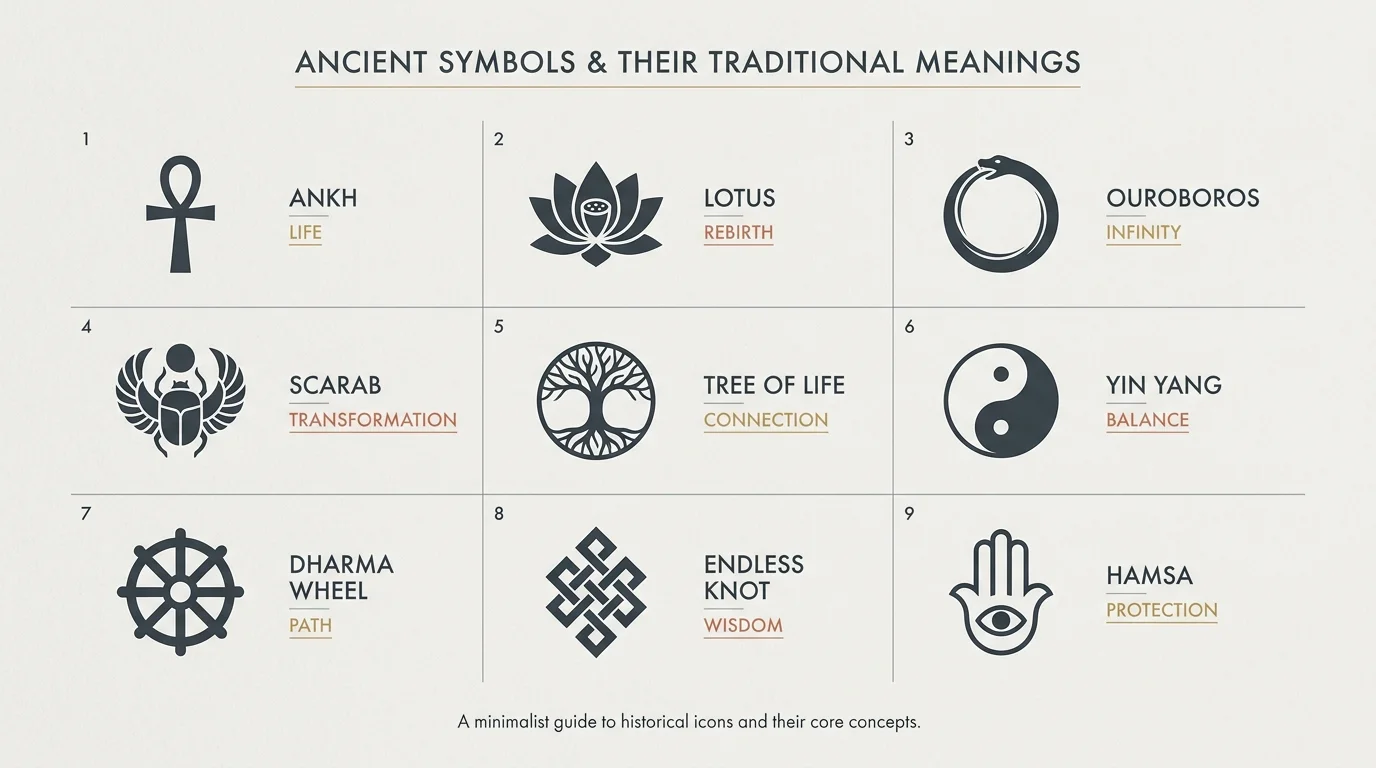
The lotus flower holds profound significance in Eastern traditions, particularly within Hinduism and Buddhism. This remarkable plant roots itself in dark, murky mud but grows upward through the water to bloom beautifully in the sunlight. Culturally, it represents resilience, spiritual awakening, and the ability to thrive despite difficult circumstances. Many traditions hold that the lotus proves beauty can emerge from the darkest periods of our lives.
You can apply the wisdom of the lotus flower to your own journey of overcoming adversity. Try a simple journaling prompt to activate this symbol. Write down one difficult situation from your past that felt like muddy water. Next, write down three specific ways you grew stronger or more compassionate because of that struggle. Whenever you feel overwhelmed, picture the lotus rising above the water to remind yourself of your innate resilience.
2. The Tree of Life
You will find the Tree of Life in ancient Celtic texts, Norse mythology, and various Indigenous cultures around the world. It features deep roots reaching into the earth and expansive branches stretching toward the sky. This ancient symbols meaning centers on connection, grounding, family heritage, and the link between the physical and spiritual realms. It reminds us that we are supported by the generations that came before us.
To integrate this life symbol into your routine, try a mindful grounding exercise. Sit in a comfortable chair with your feet flat on the floor. Close your eyes and visualize strong roots growing from the soles of your feet deep into the soil. Imagine drawing up calm, stabilizing energy from the earth. This brief visualization works wonderfully to center your mind before visiting a doctor or attending a challenging family gathering.
3. The Labyrinth
Unlike a maze designed to confuse you with dead ends, a labyrinth contains a single, winding path leading to the center and back out again. Ancient Greeks and medieval Christians used labyrinths for pilgrimage and contemplative prayer. The labyrinth symbolizes the journey of life, representing the inward path toward self-discovery and the outward path of returning to the world with newfound wisdom.
You do not need to walk a life-sized labyrinth to gain its benefits. You can practice finger tracing as a quick, calming tool. Print or draw a simple labyrinth design on a piece of paper. Slowly trace the path with your index finger, taking a deep breath in as you move toward the center, and exhaling fully as you trace your way back out. This slows your heart rate and anchors your racing thoughts.
4. The Om (Aum)
The Om is a sacred sound and spiritual icon in Indian religions. It is considered the original vibration of the universe, representing the past, present, and future encompassing all of existence. Visually, the symbol contains curves and dots that represent different states of consciousness, from deep sleep to absolute spiritual awakening. It serves as a reminder of universal harmony.
You can use the concept of Om to improve your daily breathwork. When you feel anxious or disconnected, focus on the physical vibration of sound. Take a deep breath and softly hum or chant the sound out loud. Notice how the vibration feels in your chest and throat. Research suggests that vocal toning and humming stimulate the vagus nerve, which actively helps shift your nervous system out of a stress response.
5. The Yin and Yang
Rooted in ancient Chinese philosophy, the Yin and Yang symbol illustrates how opposite forces are actually interconnected and mutually reliant. The dark swirl (Yin) and the light swirl (Yang) each contain a dot of the other color, showing that nothing is purely black or white. This spiritual symbols guide highlights the Yin and Yang as the ultimate emblem of balance, acceptance, and the natural cycles of life.
Use the Yin and Yang to practice emotional acceptance, particularly during periods of grief or life transition. When you experience a joyful moment, you might suddenly feel guilt about a recent loss. Remind yourself of this symbol. Allow yourself to hold two opposing emotions at once. Acknowledge that you can feel profound sadness and genuine gratitude on the exact same day without one invalidating the other.
6. The Ankh
The Ankh is an ancient Egyptian hieroglyph shaped like a cross with a teardrop loop at the top. It translates directly to “life” and was often depicted in the hands of gods and pharaohs to represent eternal existence and the breath of life. Today, people view the Ankh as a powerful reminder of endurance, legacy, and the impact we leave behind.
Reflect on the Ankh by considering your own legacy. Legacy does not require massive wealth or fame; it lives in the kindness you show and the wisdom you share. Take fifteen minutes this week to write a short letter to a younger family member or friend. Share a simple life lesson you have learned. This action honors the concept of enduring life by passing your vital energy and knowledge forward.
7. The Mandala
Mandalas are intricate, geometric designs radiating from a central point, utilized heavily in Hindu and Buddhist traditions as tools for meditation. The word translates to “circle” in Sanskrit. Monks sometimes spend days creating elaborate sand mandalas, only to sweep them away upon completion to honor the impermanence of life. They represent wholeness, internal order, and the vastness of the universe.
Drawing or coloring a mandala offers a highly accessible way to manage daily stress. You can purchase an inexpensive adult coloring book or simply draw concentric circles on a notepad. Focus entirely on the repetitive motion of the pen or pencil. This mindful creativity acts as a gentle distraction for an anxious brain, drawing your attention away from worries and grounding you firmly in the present moment.
8. The Hamsa (Hand of Fatima)
The Hamsa is a palm-shaped amulet recognized across the Middle East and North Africa, deeply respected in both Islamic and Jewish traditions. It frequently features an eye in the center of the palm. Historically, it serves as a protective talisman meant to ward off the evil eye and bring health, fortune, and happiness to the wearer. It symbolizes the power to stop negative energy in its tracks.
Translate the protective nature of the Hamsa into everyday emotional boundary setting. As you grow older, protecting your peace becomes essential. Use the imagery of the raised hand as a silent, mental cue to say no. When someone asks you to commit to an obligation that drains your energy, visualize the Hamsa. Give yourself permission to firmly but politely decline, establishing a healthy boundary that protects your wellbeing.
9. The Endless Knot
Originating in Tibetan Buddhism, the Endless Knot features a continuous, looping line with no clear beginning or end. It represents the intertwining of wisdom and compassion, the interconnectedness of all living things, and the eternal nature of time. It beautifully illustrates how every action ripples outward to affect the broader tapestry of existence.
You can use the Endless Knot to map the evolving shape of your own experiences, especially regarding loss. Grief does not follow a straight line; it loops and returns, changing shape over time. When you feel frustrated that you are taking steps backward in your healing process, recall the Endless Knot. Accept that your journey is continuous and complex. Give yourself grace as you navigate the winding loops of your unique path.